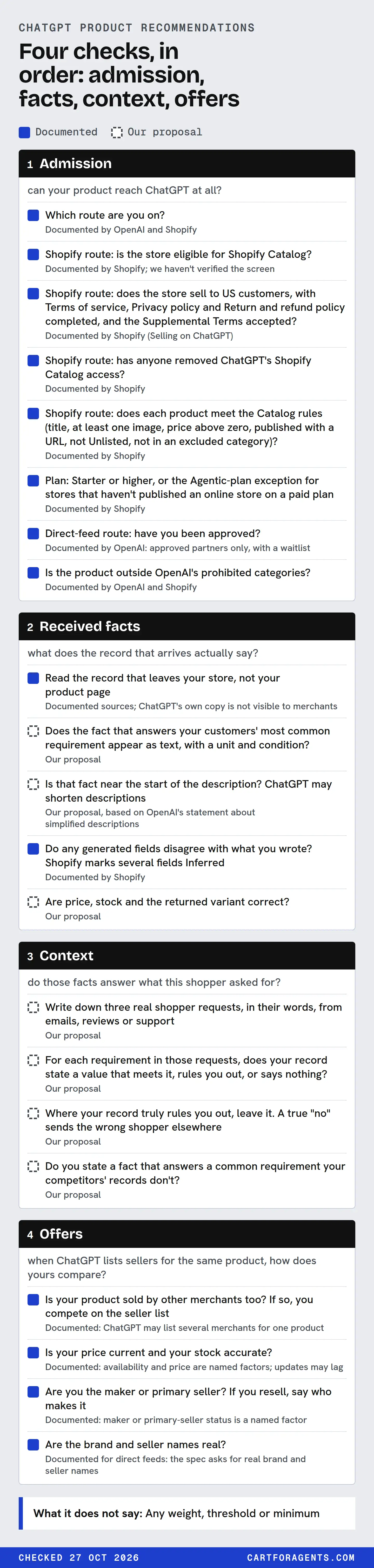
There’s no setting, fee or trick that puts a product into ChatGPT’s recommendations. OpenAI says its product results “are not ads, nor influenced by any OpenAI partnerships.” What OpenAI does publish is a list of things ChatGPT looks at. Those fall into four checks, and they’re worth running in order:
- Admission: can your product reach ChatGPT at all?
- Received facts: what does the record that arrives actually say?
- Context: do those facts answer what this shopper asked for?
- Offers: when ChatGPT lists sellers for the same product, how does yours compare?
OpenAI names the inputs, never the weights. So the honest goal is a product ChatGPT can check and compare, not a guaranteed slot. Everything below was checked on October 27, 2026; re-check before acting, because these pages change. When this page says “documented”, it means a current OpenAI or Shopify page says it. When it says “our proposal”, it’s our method.
What OpenAI actually says it uses
Start from the source, not from a vendor’s ranking-factor list. On October 27 we re-read OpenAI’s help article, “Shopping with ChatGPT Search”, and its merchant page. Here is everything in them that bears on whether a product gets shown.
| Stage | What OpenAI says | Where it says it | What it does not say |
|---|---|---|---|
| Which product appears | It appears when ChatGPT “perceives it to be relevant to your intent”, considering the query and context such as Memory or Custom instructions. A stated budget makes ChatGPT “focus more on price”. Not every available product will be shown | Help article, “How product results are selected” | Any weight, threshold or minimum |
| What it reads | Structured metadata from first- and third-party providers (such as price and description), other third-party content, earlier model responses, and OpenAI’s safety standards and policies | Same section | Which provider supplied your record |
| How it rewrites | It “may generate simplified product titles and descriptions”. Labels like “Most popular” are generated and “not guarantees or verified statements”. Review summaries come from public websites, and reviews “are not verified by OpenAI” | “Product descriptions, labels, reviews, and ratings” | Which facts survive simplification |
| Which seller is listed | Merchants are ranked “based on factors like availability, price, quality, and whether they are the maker or primary seller” | “How merchants are selected” | Whether that list is complete |
| How data gets in | Shopify merchants’ data is “already integrated into ChatGPT through Shopify Catalog” and “No additional work is required”. Others can apply for a direct feed | Same section; merchant page | Whether any store or product is eligible |
| Prices | Prices come from third-party providers, and updates to price or shipping may take time to show | “Pricing” | How long the delay is |
Two things follow. First, “ranking” in ChatGPT is really two separate choices: which product is relevant, then which seller is listed for it. Second, everything you control lives in the record: the facts it states and the offer it carries.
The checklist
This is our proposed order. Each row says what to check, what to keep as evidence, and whether the rule comes from a document or from us. “Not documented” means we looked and the current pages don’t say.
Stage 1: Admission
| Check | Evidence to keep | Status |
|---|---|---|
| Which route are you on? Shopify stores reach ChatGPT through Shopify Catalog; other merchants apply for a direct feed | A note of your platform and whether you’ve applied | Documented by OpenAI and Shopify |
| Shopify route: is the store eligible for Shopify Catalog? | What the Agentic section of your admin shows: a product count or “Ineligible” and its reason | Documented by Shopify; we haven’t verified the screen |
| Shopify route: does the store sell to US customers, with Terms of service, Privacy policy and Return and refund policy completed, and the Supplemental Terms accepted? | Your policy pages and markets settings, dated | Documented by Shopify (Selling on ChatGPT) |
| Shopify route: has anyone removed ChatGPT’s Shopify Catalog access? | The ChatGPT channel setting, dated | Documented by Shopify |
| Shopify route: does each product meet the Catalog rules (title, at least one image, price above zero, published with a URL, not Unlisted, not in an excluded category)? | One line per product you care about | Documented by Shopify |
| Plan: Starter or higher, or the Agentic-plan exception for stores that haven’t published an online store on a paid plan | Your plan name | Documented by Shopify |
| Direct-feed route: have you been approved? | Your application date and any reply | Documented by OpenAI: approved partners only, with a waitlist |
| Is the product outside OpenAI’s prohibited categories? | The category, checked against OpenAI’s policy | Documented by OpenAI and Shopify |
If Stage 1 fails, nothing later matters. Our troubleshooting guide walks through each failure in order.
Stage 2: Received facts
| Check | Evidence to keep | Status |
|---|---|---|
| Read the record that leaves your store, not your product page | The Shopify Catalog record or search preview; for a direct feed, the row in your file | Documented sources; ChatGPT’s own copy is not visible to merchants |
| Does the fact that answers your customers’ most common requirement appear as text, with a unit and condition? | The quote, and the field it sits in | Our proposal |
| Is that fact near the start of the description? ChatGPT may shorten descriptions | Its position in the description | Our proposal, based on OpenAI’s statement about simplified descriptions |
| Do any generated fields disagree with what you wrote? Shopify marks several fields Inferred | Both values, side by side | Documented by Shopify |
| Are price, stock and the returned variant correct? | The record’s values against your admin, dated | Our proposal |
Stage 3: Context
| Check | Evidence to keep | Status |
|---|---|---|
| Write down three real shopper requests, in their words, from emails, reviews or support | The requests | Our proposal |
| For each requirement in those requests, does your record state a value that meets it, rules you out, or says nothing? | A row per requirement | Our proposal (method) |
| Where your record truly rules you out, leave it. A true “no” sends the wrong shopper elsewhere | The fact and its source | Our proposal |
| Do you state a fact that answers a common requirement your competitors’ records don’t? | A short comparison with two or three competitors | Our proposal |
OpenAI’s own example shows why this stage matters. If a shopper says they dislike clowns, ChatGPT “may leave out clown costumes”. The shopper’s context removes products, and you can’t see that context. What you can do is make sure your record answers the requirements your real customers state.
Stage 4: Offers
| Check | Evidence to keep | Status |
|---|---|---|
| Is your product sold by other merchants too? If so, you compete on the seller list | A list of other sellers you know of | Documented: ChatGPT may list several merchants for one product |
| Is your price current and your stock accurate? | Today’s price and stock, dated | Documented: availability and price are named factors; updates may lag |
| Are you the maker or primary seller? If you resell, say who makes it | Your brand and maker facts | Documented: maker or primary-seller status is a named factor |
| Are the brand and seller names real? | Your record’s brand and seller fields | Documented for direct feeds: the spec asks for real brand and seller names |
A worked case: one humidifier record through the four checks
This is a labelled hypothetical. Imagine a Shopify store selling a top-fill humidifier, asking why ChatGPT doesn’t seem to recommend it for “humidifier for dry winter air large room quiet top fill”. We can’t see ChatGPT’s results, so the case uses what we can read: the ten records Shopify Catalog returned for that exact search on October 26, 2026.
Admission. Our hypothetical store would check its Agentic section, its US selling, its policies and its plan. Nothing about copy yet. If the store isn’t in Shopify Catalog, the rest is moot.
Received facts. Here the real records are telling. A decibel figure appeared in the description of 4 of the 10 records (positions 2, 3, 5 and 7). Counting Shopify-generated metadata too, it appeared in 6 of 10 (adding positions 6 and 9). It appeared in no title. Position 8 said “ultra-quiet”, with no number. “Top fill” was in 7 descriptions plus 1 title.
So the shopper asked for “quiet”, and the records answered in three different ways: a number in the description, a number only in Shopify’s generated fields, or an adjective. If our hypothetical store’s record said “ultra-quiet”, it would be giving ChatGPT a word to repeat and nothing to compare. And since Shopify marks both the description and the generated lists as Inferred, the store should confirm the number it wants shown is in its own text.
Context. Does stating the number matter? We can’t measure that in ChatGPT. We did test the idea in a supplied-snippet simulation: an invented humidifier among seven real listings, where each model picked 2 of 8, so random picking is 25%. With vague copy it was almost never picked: 3 of 180 Claude sessions, 0 of 60 on GPT-6.1-Sol, 6 of 60 on Gemini 3.8 Flash and 3 of 54 on Gemini 3.1 Pro. With its facts as a spec line: 134 of 180, 20 of 60, 19 of 59 and 15 of 55. On GPT and both Gemini models it was picked in every session where the shopper’s detailed brief asked for what it stated (20 of 20, 19 of 19, 15 of 15), and in none with a one-line ask or no shopper (0 of 40 on each). In the snippets the models saw, it was the only listing under USD 90 that stated a room size; several competitors stated runtimes.
The lesson: vague copy gets excluded, facts get you considered, and you win when your facts answer a stated need that competitors’ listings don’t. It’s a simulation with snippets we supplied, not ChatGPT shopping.
Offers. If the same humidifier is sold by several stores, ChatGPT’s seller list is a separate contest: availability, price, quality, and maker or primary-seller status. A reseller with perfect copy can still sit below the maker.
The order matters. Rewriting copy for a store that isn’t in Shopify Catalog, or that sells only to Canada, fixes nothing.
What the documents rule out
A few common beliefs don’t survive a read of the current pages.
- “Pay to rank.” OpenAI says product results aren’t ads and aren’t influenced by partnerships. Ads are a separate product.
- “There’s a minimum review score.” OpenAI names reviews as something ChatGPT may consider, and says review summaries come from public websites. It doesn’t publish a threshold, and neither do we.
- “A Shopify app will get me into ChatGPT.” Both companies say the Shopify Catalog route needs no extra work from an eligible store. An app can’t make an ineligible store eligible.
- “Checkout inside ChatGPT is the goal.” On October 27, OpenAI’s merchant page said it is “moving away from a standalone Instant Checkout experience” and that purchases are completed on merchant-owned sites or apps. Its help article still mentioned Instant Checkout for “some eligible products and merchants”. Shopify says ChatGPT shoppers complete purchases on your own online store checkout. In our October 26 snapshot, all 1,620 Shopify Catalog results had native checkout set to false on their first variant, in one unpersonalized context. Plan for the click to your store.
Market and availability
| Question | What the pages say | Source |
|---|---|---|
| Where is ChatGPT shopping live? | “Currently live for ChatGPT users in the U.S.” | OpenAI merchant page |
| Can a Canadian Shopify store take part? | The store must sell to US customers but “can be based outside the United States” | Shopify, Selling on ChatGPT |
| Is ChatGPT shopping live for Canadian shoppers? | Not documented in the pages we read. OpenAI says it plans to expand to more regions | OpenAI merchant page |
| Direct feeds outside the US | The standard upload “currently targets the US”; other markets need OpenAI to confirm your integration | OpenAI products spec |
| Device availability | “Available in ChatGPT on mobile and web” | OpenAI help article |
How we checked
On October 27, 2026 we read OpenAI’s help article “Shopping with ChatGPT Search” (it showed “Updated” earlier that day), OpenAI’s merchant page, OpenAI’s product file upload specification, and Shopify’s pages on selling on ChatGPT, managing agentic storefronts and Shopify Catalog requirements. Every “documented” row above quotes or paraphrases those pages as they read on that date. We didn’t log into any Shopify admin, so menu names come from Shopify’s help text.
The humidifier counts come from a Shopify Catalog search we saved on October 26, 2026, with no buyer or country context, top 10 results. The simulation is described in full on its own page. For the feed route in detail, see our ChatGPT product feed guide. For a whole-store review, see the AI visibility audit.
Your next step
Pick your best-selling product and write four lines, each with today’s date:
- Admission: your route, and what your admin or OpenAI says about eligibility.
- Received facts: the one fact your customers ask about most, quoted from the record that leaves your store, with the field it sits in.
- Context: one real customer request, and whether that fact answers it.
- Offers: who else sells this product, and whether you’re the maker.
The first line you can’t fill in is where to start.