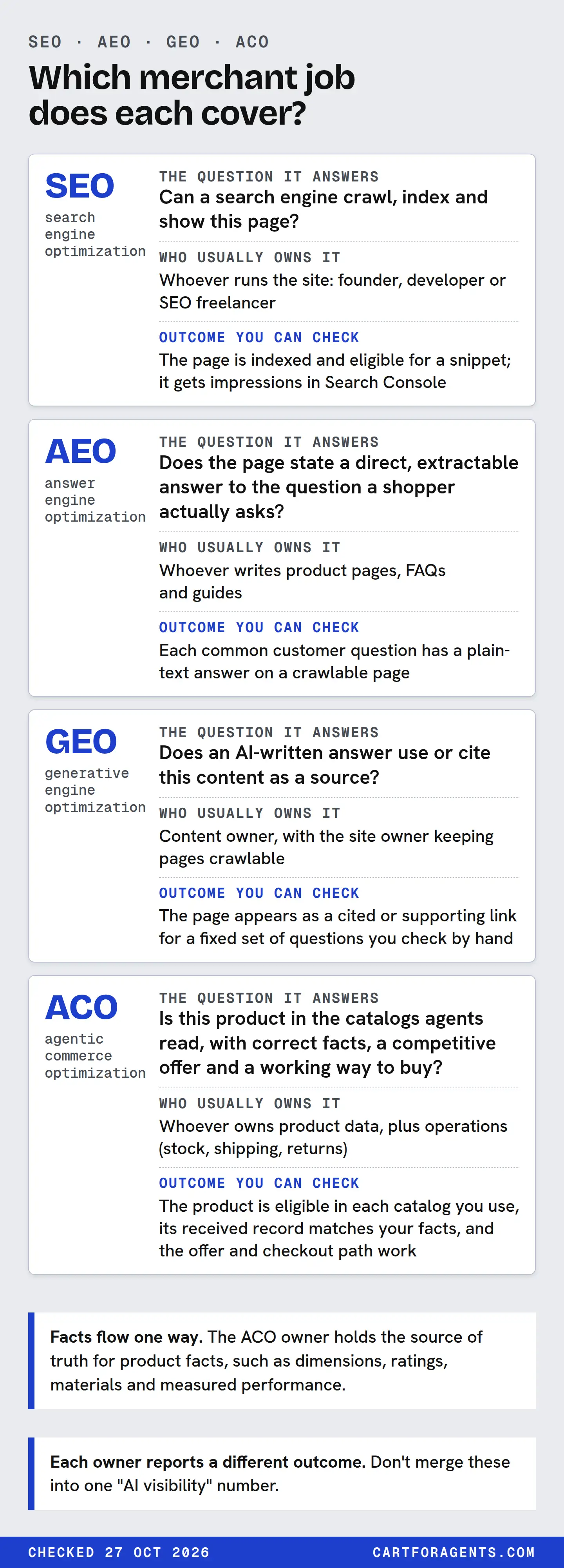
SEO, AEO, GEO and ACO describe four different jobs. SEO gets your pages crawled, indexed and shown in search. AEO and GEO are industry names for getting your content used or cited inside AI-written answers; neither has an official definition. ACO is a newer name for making product records eligible, accurate and buyable by AI shopping agents.
On a small Shopify store, those jobs usually belong to different people: whoever runs the site, whoever writes the content, and whoever owns product data and operations. Each job has its own check. Only one of them has an official rulebook: Google says its AI features need nothing beyond normal SEO. The rest of this page assigns each job an owner and an outcome you can verify.
The responsibility table
This is the page in one table. Read across a row to see what the job is for, who should own it, and what you’d look at to know it’s done. The owner column is our proposal for a store with a founder and a few helpers. It isn’t an industry standard.
| Job | The question it answers | Who usually owns it | Outcome you can check |
|---|---|---|---|
| SEO: search engine optimization | Can a search engine crawl, index and show this page? | Whoever runs the site: founder, developer or SEO freelancer | The page is indexed and eligible for a snippet; it gets impressions in Search Console |
| AEO: answer engine optimization | Does the page state a direct, extractable answer to the question a shopper actually asks? | Whoever writes product pages, FAQs and guides | Each common customer question has a plain-text answer on a crawlable page |
| GEO: generative engine optimization | Does an AI-written answer use or cite this content as a source? | Content owner, with the site owner keeping pages crawlable | The page appears as a cited or supporting link for a fixed set of questions you check by hand |
| ACO: agentic commerce optimization | Is this product in the catalogs agents read, with correct facts, a competitive offer and a working way to buy? | Whoever owns product data, plus operations (stock, shipping, returns) | The product is eligible in each catalog you use, its received record matches your facts, and the offer and checkout path work |
Two things in that table do most of the work.
First, the jobs stack. A product page that can’t be indexed won’t be a supporting link in Google’s AI features, because Google says a page must be indexed and eligible for a snippet to qualify. ACO adds a route that doesn’t depend on your pages at all: Shopify Catalog sends product records straight to agentic storefronts. Doing one job well doesn’t finish the others.
Second, the outcomes are different units. An indexed page, an answer that quotes you, a citation and a product shown with your offer are four different things to count. Our ACO vs GEO measurement guide sets out how to count each one. This page stops at who owns what.
What each term means, and who defined it
Before assigning owners, it helps to know which of these words have a source behind them.
| Term | Where the definition comes from | What it covers | What it doesn’t cover |
|---|---|---|---|
| SEO | Search engines’ own documentation, such as Google Search Central | Crawling, indexing, page quality, structured data that matches the visible page | What an AI answer says, whether a product is in a shopping catalog, checkout |
| AEO | Industry usage only. We found no official definition | Writing so a direct answer can be lifted out of the page | Being cited, product records, purchases |
| GEO | A 2023 research paper by Aggarwal and co-authors, later accepted to KDD 2024 | Making content more visible as a source inside generated answers | Product selection, seller choice, purchases |
| ACO | Vendor and trade usage. ReFiBuy says it named and defined it | Product eligibility, product facts, competitiveness in AI shopping | Ranking ordinary web pages |
AEO and GEO are often used interchangeably in industry writing; neither has an official standards-body definition we could find. We keep them as separate rows only to show different checks, and we separate them for one practical reason: answering a question clearly is a writing job you can do today, while being cited is an outcome someone else’s system decides. Keeping them apart stops a team from calling the writing finished because one assistant once cited the page.
The GEO paper’s own framing matters too. It’s about content creators’ visibility in answers, and it measured that on a benchmark, not product purchases. Our guide to how shopping agents choose products covers what that kind of research does and doesn’t show for stores.
ACO is the job with the least agreement on its name. ReFiBuy defines it as making products “understandable, eligible, and competitive” in AI shopping and says it named the discipline. We haven’t verified who used it first. Our ACO test plan lists the prior uses we found.
Where each job’s rules come from
The jobs also differ in how much the platforms document. That changes how confident each owner can be.
| Job | What the platform documents | What stays unknown |
|---|---|---|
| SEO | Google: indexing and snippet eligibility are required for AI Overviews and AI Mode supporting links; no AI text files or special schema needed; important content in text; structured data matching visible text | Whether a given indexed page is shown. Google says indexing and serving aren’t guaranteed |
| AEO and GEO | Google: AI features may use “query fan-out”, running related searches to build a response. OpenAI: ChatGPT shopping considers structured metadata and other third-party content | Which passage an answer uses, or why one source is cited over another. No weights are published |
| ACO: catalog and facts | Shopify: Catalog eligibility rules, what’s syndicated, and that generated fields exist. OpenAI: for Shopify merchants, product data is integrated through Shopify Catalog | How each assistant ranks products once it has the record. Shopify itself says channels re-rank |
| ACO: offer and operations | OpenAI: merchants ranked on availability, price, quality and maker or primary-seller status. Google Store Quality: shipping, returns, browsing and purchase experience | How much each factor counts. Google says Store Quality rewards; it doesn’t penalize |
A few lines from those documents settle common arguments:
- “Do we need an llms.txt or special AI schema for Google?” Google says no: no new machine-readable files, AI text files or special schema.org markup to appear in AI Overviews or AI Mode. Shopify already serves
/agents.md,/llms.txtand/llms-full.txtfor every store and says these don’t replace Shopify Catalog. - “If we block AI crawlers, are we out of AI shopping?” Not on Shopify. Shopify says blocking crawlers in robots.txt affects only open-web discovery. It doesn’t stop Shopify Catalog sending product data to the agentic storefronts you’ve activated. That’s the SEO owner’s lever and the ACO owner’s lever pulling on different routes.
- “Is Google Store Quality an AI ranking score?” Google describes it as a reward program. Merchants who don’t meet a level aren’t penalized; they just don’t get the badge and other benefits. Separately, Google Shopping says its “Top recommendations” use relevance, ratings, price and product features.
A worked case: one fact, four owners
Take one shopper question: how loud is this humidifier? On October 26, 2026 we searched Shopify’s agent catalog for “humidifier for dry winter air large room quiet top fill” and saved the top 10 records.
A decibel figure appeared in the description of 4 of the 10 listings. Counting Shopify-generated metadata as well, it appeared in 6 of 10. It wasn’t in any title. One listing’s description gave no noise figure, but the spec list Shopify generated for it said “As low as 26 dB”. Shopify marks fields like that as Inferred: generated or enriched by Shopify, not merchant-written text.
Here’s how the four jobs split that one fact:
| Job | What the owner does with the noise figure | Done when |
|---|---|---|
| SEO | Makes sure the product page is crawlable and indexed, and that the figure is in page text, not only in an image | The page is indexed and the figure is in the visible text |
| AEO | Writes the answer plainly near the top: the decibel figure, the setting and the distance it was measured at, if known | A reader can find “how loud?” answered in one sentence |
| GEO | Checks, on a fixed list of questions, whether AI answers cite or link the page. Changes nothing to “game” it | Results are logged with date, platform and question; no single citation is treated as proof |
| ACO | Compares the catalog record with the merchant’s own facts. Confirms or corrects the generated 26 dB, and publishes the real figure with its condition | The received record and the merchant’s verified fact agree, field by field |
The trap is assuming the SEO owner’s work covers the ACO job. The product page could be perfectly indexed while the catalog record carries a noise figure the merchant never wrote. Or a well-written description could sit on a page Google can’t index. Each owner checks a different object: the page, the answer, the citation, the record.
That listing’s owner has a concrete ACO task: find where “26 dB” came from, then either publish it in their own description with its measurement condition or get it corrected. Our agent-ready product data guide has a template for recording a fact like that with its source.
Assigning owners on a small team
Most Shopify stores don’t have four teams. Owner assignments below are our proposed split for a small Shopify team, not roles any platform assigns. The point of the table is to make sure each job has a name next to it, even if it’s the same name twice.
| If your store has… | SEO | AEO and GEO | ACO |
|---|---|---|---|
| A solo founder | Founder, with a developer for fixes | Founder | Founder for facts; whoever packs orders for stock and shipping truth |
| A founder and a content freelancer | Founder or developer | Freelancer, with the founder signing off on facts | Founder |
| A small team | Developer or SEO lead | Content lead | Merchandiser or catalog owner, plus operations |
Two rules make the split work:
- Facts flow one way. The ACO owner holds the source of truth for product facts, such as dimensions, ratings, materials and measured performance. Content writers quote it; they don’t invent or round it. A sentence that sounds good but contradicts the spec sheet is an ACO problem disguised as a writing win.
- Each owner reports a different outcome. The SEO owner reports indexing and Search Console data. The content owner reports which customer questions now have answers on the page. The ACO owner reports eligibility, record accuracy and offer health. Don’t merge these into one “AI visibility” number. Our AI visibility guide explains why a mention, a citation and a sale need separate labels.
What these labels won’t do for you
None of these jobs can make an assistant choose your product. OpenAI says ChatGPT picks products by relevance to the shopper’s query and context, and ranks sellers separately. Shopify says agentic storefronts often re-rank its catalog results. Google says serving isn’t guaranteed even when every requirement is met.
What the labels can do is stop work falling through the gaps between them. The gap in the worked case is a typical one: a page that’s fine for search, and a product record that nobody owns.
When you’re ready to turn this into a task list, our GEO for ecommerce backlog takes these definitions and turns them into prioritized tasks with owners and acceptance checks. For the assistants themselves, and which controls you have on each, see AI shopping agents: compare capabilities and merchant controls.
Your next step
Copy the responsibility table and write one name in the owner column of each row. Then pick your best-selling product and run the four checks once: is the page indexed, is the top customer question answered in text, have you logged whether it’s cited for three real questions, and does the catalog record match your own facts? Any row without a name, or any check nobody can answer, is where to start.