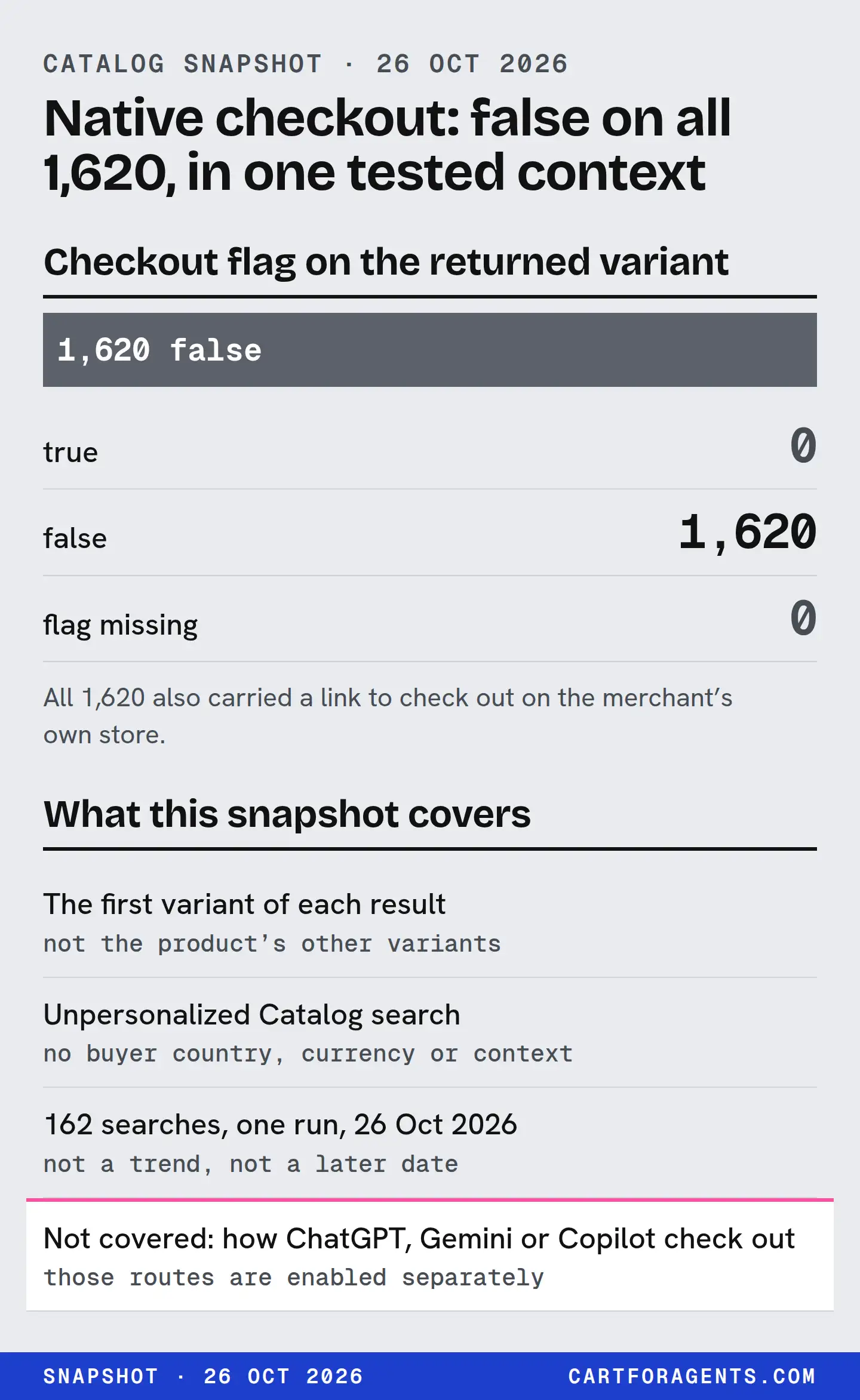
In our Shopify Catalog snapshot from October 26, 2026, the native-checkout flag was false on all 1,620 results. That’s a real observation and it’s easy to overstate. Every one of those same records also carried a link to buy the product on the seller’s own store. So the accurate sentence is narrow: in this search context, the variant each result returned did not support checkout without a redirect. It doesn’t say the product couldn’t be bought, that a shopper in Toronto or Ohio would see the same flag, or whether the store uses ChatGPT Instant Checkout or Copilot Checkout.
This page recounts the flag and the fields around it, then gives you a way to report a flag without claiming more than the record holds.
What the flag is
Shopify Catalog’s results carry, on each returned variant, a field called eligible.native_checkout. Shopify’s reference defines it as “whether this variant supports native (non-redirect) checkout.” (Global Catalog extension, “Variant fields”, checked October 27, 2026.)
Native here means the purchase can complete without sending the shopper away to the store. False means the route Shopify offers for that variant is a redirect: the record’s own checkout link.
One oddity worth knowing if you ever read these records yourself. The reference page says the field’s default is false. Shopify’s published JSON schema for the same version, 2026-08-25, says the default is true. (Schema, checked October 27, 2026.) The two disagree. It didn’t affect our count, because the field was explicitly present on every one of the 1,620 results. But if you ever meet a record without the field, write “not stated”. Don’t fill in either default.
The recount
We sent 162 shopper searches in 16 categories, with no country, currency or buyer, and kept the top 10 results of each: 1,620 results, not 1,620 distinct products. Here is everything in those results that bears on checkout, read from the one variant each result returned.
| Field on the returned variant | Results | What it shows |
|---|---|---|
| Native checkout: false | 1,620 of 1,620 | No returned variant supported non-redirect checkout in this context |
| Native checkout: true | 0 | The same fact, counted the other way |
| Checkout link present | 1,620 of 1,620 | Every one was a cart link on the seller’s own storefront |
| Marked available | 1,617 (3 not) | Stock signal at that moment |
| Variants returned per result | Exactly 1, on all 1,620 | The flag covers one variant per product |
| Listed other options (an option with 2+ values) | 758 | At least 758 results had variants whose flags we never saw |
| Seller is a Shopify shop | 1,620 of 1,620 | None was an external offer (see below) |
| Checkout prerequisites field present | 0 | Whether shipping or a selling plan was required is unknown |
| Price in US dollars | 1,568 (52 in 11 other currencies) | Even with no country set, each result carried one market’s offer |
The false flag held in all 16 categories. Nothing in the snapshot varies with it, which is why it can’t explain anything else in the data either. A field that’s the same on every record can’t tell you why one product did better than another.
A worked record
Here is the first result for “waterproof dog boots for small dogs in deep snow”, with the store’s name and link removed. Its product lists 10 colours and 8 sizes as options. The search returned one variant.
| Field | What the record says |
|---|---|
| Returned variant | Size 1, green |
| Price | USD 36.00 |
| Available | true |
| Native checkout | false |
| Checkout link | A cart link on the seller’s own storefront domain, for this variant, quantity 1 |
Read literally, that record says: this one variant, offered to an unidentified buyer in US dollars, buys through the store’s own cart. It says nothing about the other colours and sizes, and nothing about a signed-in buyer in another country.
The variant a search returns isn’t even fixed. One product ID appeared in two different searches in our snapshot and came back with a different first variant each time, from the same seller. A flag read on “the first variant” is a flag read on whatever variant that particular search happened to return.
What “false on 1,620” supports, and what it doesn’t
| Statement | Supported by this snapshot? | Why |
|---|---|---|
| “In this snapshot, no returned variant supported non-redirect checkout” | Yes | That’s the recorded value, field and context |
| “These products couldn’t be bought through an agent” | No | Every returned variant carried a checkout link to the seller’s store. A redirect is still a way to buy |
| “Shopify products don’t support native checkout” | No | One variant per product, no buyer, no country, and 1,620 results that aren’t a sample of Shopify |
| “These stores aren’t in ChatGPT Instant Checkout or Copilot Checkout” | Not tested | Shopify doesn’t document this flag as either program’s switch, and we never looked inside an assistant |
| “These stores aren’t eligible for Shopify Catalog” | No | They were returned, so they were in the catalog |
| “Native checkout would have ranked them higher” | Not tested | Every record had the same value, so the snapshot holds no comparison |
Two of those rows deserve one more line each.
Catalog inclusion is a different gate. Shopify’s requirements for being included in Shopify Catalog cover the store, the account and each product. For example, the store must be on the Starter plan or higher and not in private mode. There’s an exception: on the Agentic plan, products can still be included through agentic storefronts before the online store is published to a paid plan. (Requirements for being included in Shopify Catalog, checked October 27, 2026.) The general requirements on that page cover the plan, the products and where they’re published; they don’t mention native checkout. And our 1,620 results, every one flagged false, were all in the catalog.
Assistant checkout programs have their own rules. OpenAI says ChatGPT’s product results link to sites where the shopper can learn more or purchase, and that “for some eligible products and merchants” it may also show an Instant Checkout option. (Shopping with ChatGPT Search, checked October 27, 2026.) When it launched Instant Checkout in 2025, OpenAI said those items “are not preferred in product results”. It also said that when ranking several merchants selling the same product, ChatGPT considers whether Instant Checkout is enabled, alongside availability, price, quality and primary-seller status. (OpenAI, September 29, 2025.) The current help page lists merchant-ranking factors without naming Instant Checkout. Neither page mentions Shopify’s flag. How Copilot Checkout and Google’s checkout work for Shopify merchants is covered in our guide to Shopify agentic storefronts.
Rule out external offers first
Shopify’s Global Catalog can also return external offers in a beta. These are products indexed from a merchant’s own website rather than published through Shopify. For those, Shopify says native_checkout is always false, there’s no checkout link, and the purchase stays on the merchant’s site. (Global Catalog extension, “External variant differences”, checked October 27, 2026.)
That matters for anyone counting flags. In a snapshot that mixes sources, external offers will pull the false count up by design. Ours didn’t mix: every seller carried a Shopify shop ID, every variant a Shopify variant ID, and every variant a checkout link. So none of our 1,620 false flags came from that rule. If you collect your own snapshot, separate external offers before you count anything.
How to report a checkout flag
Here’s a proposed template. Fill every bracket; if you can’t, say “not recorded” rather than leaving it out.
On [date and time zone], a [route and tool version] search for “[exact query]”, with [country / currency / postal code / signed-in buyer, or “none”], returned [n] results. On the [first / chosen] variant of each,
eligible.native_checkoutwas [true] on [k] and [false] on [n − k]; [m] results were external offers. This describes those variants in that context only. It does not describe other variants, other buyers, or any assistant’s checkout program.
And four checks before you publish the sentence:
- Was the field present, or are you assuming a default? The docs disagree on what the default is.
- Which variant did you read? If the product lists other options, say the other variants were not checked.
- What context did you send? Shopify documents both localization signals and personalized search for signed-in buyers. (Global Catalog MCP, checked October 27, 2026.) We sent none, so our result is the no-context case only.
- Did you separate the purchase route from the flag? Record whether a checkout link was present. “False” with a link and “false” with no link are different situations.
For your own store
A flag in someone else’s snapshot, ours included, isn’t your checkout status. If you want to know whether a shopper can buy inside a given assistant, check that program’s own settings and eligibility for your store and country. Then, if you like, search Shopify Catalog for one of your products with a country set, read the returned variant’s flag and checkout link, and write it up with the template above. We haven’t tested whether the flag changes with country or buyer, so treat your first reading as a reading, not a rule.
How a Catalog result relates to what ChatGPT actually shows is a separate question, covered in what Catalog research can and can’t say about ChatGPT.
How we checked
- Source. Shopify’s public Global Catalog, searched read-only with Shopify’s command-line tool (
@shopify/ucp-cli0.9.1, catalog protocol version 2026-08-25), with the default request (query and a limit of 10). No country, currency, postal code, buyer token or source filter. All 162 responses were saved between about 8:30 and 8:34 p.m. Eastern on October 26, 2026. The full collection method is on the snapshot page. - Recount. On October 27 we re-read every saved response with a short script. Per returned variant: the native-checkout flag, whether a checkout link was present, and whether its host matched the seller’s storefront URL. Also the availability flag, the price currency, the seller and variant ID types, and whether a prerequisites field existed. Per result: the number of variants returned and whether any product option listed more than one value.
- By hand. We checked the dog-boot record above field by field against the saved response.
- What we didn’t do. We didn’t open any checkout link, create a cart, sign in as a buyer, set a country, or ask any assistant. We read Shopify’s and OpenAI’s documentation on October 27, a day after the snapshot. They’re living pages, so they may have differed on the 26th.
Your next step
Find one sentence anywhere in your own reporting, or a vendor’s, that says what agents “can” or “can’t” buy. Rewrite it with the template above. If you can’t fill in the context and the variant, the sentence is claiming more than its evidence holds.