Publish a measured size range for every size you sell: paw width and paw length, in millimetres and inches, and how the paw was measured. Body weight is a useful second guide, not a substitute. Then tie every weather word to something you can show. Say “water-resistant” unless a test backs “waterproof”, and print no temperature rating you haven’t tested.
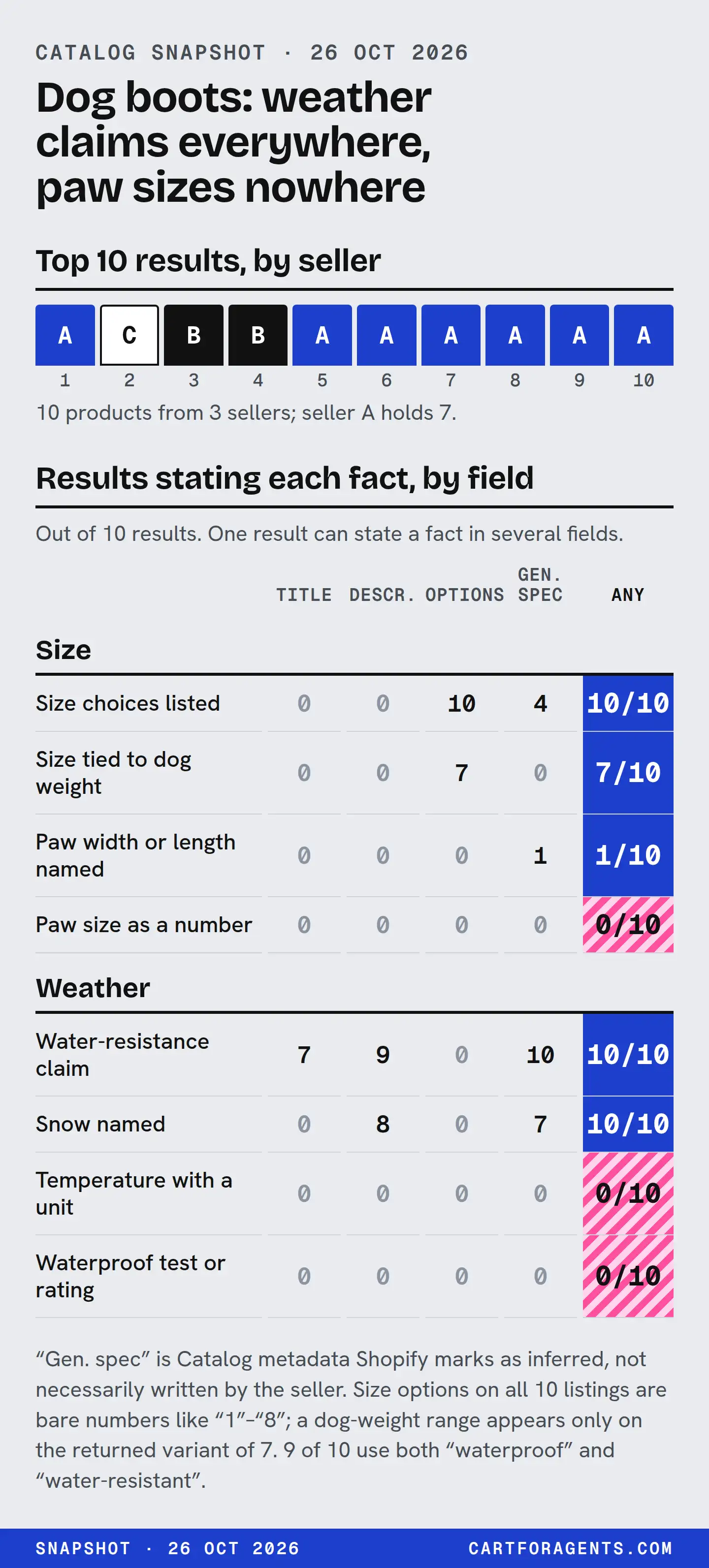
When you study what AI shopping agents see in your category, count sellers and distinct products, not results. In our October 26, 2026 snapshot of Shopify’s agent catalog, ten results for waterproof dog boots came from three sellers. Seven shared one description. None gave a paw width or length as a number.
The template below is a proposed record, not a format any platform requires.
The dog-boot shelf: ten results, three sellers
On October 26 we searched Shopify’s Global Catalog, the product catalog Shopify makes available to AI shopping channels, for “waterproof dog boots for small dogs in deep snow”. It returned ten results. Here is what those ten actually were. Store names are withheld; listings go by position.
| Positions | Seller | Description text | Size information received |
|---|---|---|---|
| 1, 5, 6, 7, 8, 9, 10 | Seller A | One description, identical word for word on all seven | First variant: “Size 1) for 14-23lbs/6.5-10.5kg” |
| 2 | Seller C | Its own description | Size option “1”; no measurement |
| 3 | Seller B | Its own description | Size option “1”; no measurement |
| 4 | Seller B | A second, different product | Size option “1”; no measurement |
Ten product IDs, but four distinct descriptions and three sellers. Seller A’s seven listings were mostly colour versions with their own product pages: “Brown”, “Black”, “Green”, “Lilac”, “Grey Camo”, plus two untitled ones carrying the full colour list.
That changes how to read the shelf. A shopper or an agent asking this question did not get ten options. They got roughly four products, and one seller’s description accounted for 70% of the results. We cover the counting in depth, across dog-boot, backpack and tent searches, in our count of products, variants and sellers.
What this means for your own listings
If you’re Seller A, splitting each colour into its own product filled seven of the ten places on this search. It added no information. Every one of those seven records carried the same facts and the same gaps, so a wrong or missing fact is wrong or missing seven times, and a fix has to be made seven times.
Shopify says its Catalog Mapping can group separate products as variants of one listing, and can pull data from custom fields such as metafields. That’s worth knowing before you add another colour as a new product. We have no evidence on whether grouping changes how often a product gets picked, so treat it as a maintenance decision, not a ranking tactic.
If you’re the smaller seller, the useful count is three sellers and four products, not ten listings. And look at what none of them said.
What the ten records said, field by field
The query asked for four things: waterproof, small dogs, deep snow and, implicitly, winter cold. Here is how many records answered each, and in which field. “Generated metadata” means the specification, feature and selling-point lists that Shopify writes and marks Inferred.
| What the shopper asked | Field | Records stating it | What they said |
|---|---|---|---|
| Waterproof | Title | 7 of 10 (all Seller A) | “Waterproof Dog Shoes” |
| Waterproof | Description | 0 of 10 used “waterproof” | 9 of 10 made a water- or weather-resistance claim: 8 said “water-resistant”, position 3 “weather-resistant”. Position 4 said only “weather protection” |
| Waterproof | Generated metadata | 2 of 10 (positions 3, 4) | “Water-resistant and waterproof design”; “Waterproof, slip resistant…” |
| Small dogs: paw size as a number | Any field | 0 of 10 | Named once, with no numbers: position 3’s generated list says sizes are “based on paw width and length” |
| Small dogs: body weight | First-variant size label | 7 of 10 (all Seller A) | “Size 1) for 14-23lbs/6.5-10.5kg” |
| Deep snow: boot height | Any field | 0 of 10 | Position 4 said “extended leg coverage”, with no measurement |
| Cold: temperature rating | Any field | 0 of 10 | Position 2 said “perfect for cold weather” |
Snow itself was mentioned everywhere: in 8 descriptions, and on all 10 records once Shopify’s generated lists are counted. Mentioning snow is not the same as saying how deep.
Three things stand out.
The title and the description disagreed. Seven titles said “Waterproof”. The descriptions on those same seven records said “Water-resistant exterior”. Those aren’t the same claim. A shopper walking a dog through slush cares which one is true, and an agent reading both fields has to pick one.
Shopify’s generated lists made the weather claim stronger. On positions 3 and 4, the merchant’s description said “weather-resistant” or “weather protection”. The generated metadata said “waterproof”. We can’t see what Shopify generated those lines from. They may come from merchant data we didn’t receive. But the word a shopper might rely on is not in the description we were given.
Sizes were labels, not measurements. Every product’s size option was a bare number: “1” to “8”, or “1” to “6” with “2 Short” and similar. Generated metadata on four records then added letter sizes such as “Small (S)” that none of those merchants’ size options used. On position 9, the variant said “Size 1) for 14-23lbs” and the generated list said “Accessory size: Small (S)”. On position 3, the generated list said sizes were “based on paw width and length”, but gave no widths or lengths.
One smaller drift is worth knowing. Position 2’s title said “Set of 4”. Its generated spec list said “Set includes: 4 pairs of dog boots”, which would be eight boots. The description gave no count.
The query said “small dogs” and “deep snow”. No listing could answer either with a number. If you can, you’d be the only one on this shelf that does. In our simulation with an invented humidifier, facts got a product considered, but it won consistently only when its facts answered something the shopper had asked for that competing listings didn’t state (details below).
The paw-measurement template
Here’s a record for each size. It works for boots, and the same shape works for coats and harnesses if you swap paw measurements for chest girth and back length.
The reason to record how the paw was measured is that sellers don’t agree. Ruffwear measures paw width with the dog standing on the paw, notes that rear paws are often smaller than front paws, and says to size down between sizes. All Dog Boots measures length and width with the paw weighted, says there’s no universal dog-boot size chart, and says to choose the larger size between sizes. A UK retailer reports that one brand it stocks measures width across the top of the paw with a cloth tape. Three methods, two opposite rules for in-between dogs. A bare “Size 3” means nothing outside its own chart.
| Field | What goes in it | Example (format only) |
|---|---|---|
| Size label | Exactly as it appears in your size option | Size 3 |
| Paw width range | Min to max, in mm and inches | [ ]–[ ] mm ([ ]–[ ] in) |
| Paw length range | Min to max, heel pad to longest nail, mm and inches | [ ]–[ ] mm ([ ]–[ ] in) |
| How the paw was measured | Standing on the paw or not, which paw, on paper or tape over the top | Front paw, standing, outline on paper |
| Between sizes | Your rule, in one line | Size [up/down] |
| Front vs rear | Whether rear paws usually take a different size in this boot | [Same / often one size smaller] |
| Body weight guide | Secondary, labelled as a guide | [ ]–[ ] lb ([ ]–[ ] kg), guide only |
| Boot height | Sole to top of cuff, mm and inches | [ ] mm ([ ] in) |
| Boots per set | Count of boots, not pairs | 4 boots |
| Source | Your size chart, pattern spec or factory sheet | [Document, page] |
| Checked | Date someone confirmed the numbers | 2026-10-27 |
The brackets are deliberate. We don’t know any real boot’s numbers, and you shouldn’t invent them. Fill them from your pattern spec or factory size sheet, and if a value doesn’t exist, write “not measured” rather than leaving a blank.
Then put the measurement into the size option itself, where it travels with the variant: “Size 3: paw width [ ]–[ ] mm”, not just “3”. A size chart in an image or a pop-up may never reach a catalog record. Seller A’s first-variant label shows that a label can carry a range into the catalog; it just carried the less useful one.
Worked example: rebuilding Seller A’s first variant
Here’s position 1 rebuilt from only what the catalog returned, then marked against the template.
| Field | What the record said | Status | Fix |
|---|---|---|---|
| Size label | “Size 1) for 14-23lbs/6.5-10.5kg” | Body weight only | Add paw width and length for Size 1 |
| Paw width / length | Not stated | Unknown | Measure, or copy from the factory size sheet |
| How measured | Not stated | Unknown | One line: which paw, standing or not |
| Water | Title “Waterproof”; description “Water-resistant exterior” | Conflict | Use the word you can back up in both fields |
| Boot height | Not stated | Unknown | Add, in mm and inches; it answers “deep snow” |
| Temperature | Not stated; “soft micro-fleece interior” | Unknown | Leave unrated unless tested |
| Boots per set | “Each set comes with 4 boots” | Stated | Keep; repeat it in a structured field |
Three of seven rows are fixable from a document the merchant almost certainly has. One is a wording decision. None needs new marketing copy.
Weather claims: use the word you can back up
Pet gear sells on three weather words: waterproof, insulated or warm, and a temperature. Each needs a source, a scope and a condition, or it shouldn’t be printed.
| Claim | What makes it checkable | Common trap | Honest fallback |
|---|---|---|---|
| Waterproof | A named test and result, and which part was tested (upper, sole, seams) | Title says waterproof, description says water-resistant | “Water-resistant upper” |
| Insulated, warm | Material and amount, for example lining type and weight if known | Fleece lining read as a cold rating | “Fleece-lined; not temperature rated” |
| Rated to a temperature | Who rated it, how, and for which part | A rating that applies to one component read as the whole product | Leave it out |
| Deep snow | Boot height or cuff height in mm and inches | “Extended coverage” with no number | State the height and let the shopper compare |
The third row is not hypothetical. In a toddler-snowsuit search from the same snapshot, one description rated the hood’s insulation to -30 °C, and Shopify’s generated spec line dropped the word hood (the record is quoted here). The same kind of scope loss can happen to “waterproof” on a boot whose sole is waterproof and whose cuff isn’t.
Pick one wording and use it in the title, the description and the spec field. If an agent reads “Waterproof” in one field and “Water-resistant” in another, you’ve made it choose, and you don’t control which one it picks.
How an agent or shopper will check your listing
This is the evaluation a careful agent, or a careful person, can run on a pet-gear listing. Use it on your own page before anyone else does.
| Shopper question | Evidence that answers it | Trap to avoid | When the product should be ruled out |
|---|---|---|---|
| Will it fit my dog’s paws? | Paw width and length per size, with the measuring method | Body weight or a bare size number only | Paw falls outside every size’s stated range |
| Will it stay dry in slush? | The waterproof or water-resistant claim, with what was tested | Title and description saying different things | Shopper needs waterproof; listing only supports water-resistant |
| Is it tall enough for deep snow? | Boot height in mm and inches | “Extended leg coverage” in words | Stated height below what the shopper needs |
| Will it keep a small dog warm? | Lining and insulation facts; a rating only if tested | Fleece lining read as a cold rating | Shopper needs a rating; none is published |
| How many am I buying? | Boots per set, as a count of boots | “Set of 4” turning into “4 pairs” | — |
The last column matters. A true “not for” fact can cost you a pick from a dog it wouldn’t have fitted, and a return you’d otherwise have paid for. Keep it visible, not buried in a size-chart pop-up.
The template above is the publishable record. A neutral field guide for people choosing dog boots is a separate job; this page is about what the merchant should publish. For the general specification format behind it, see our product specification template, and for the same approach applied to bags, travel bag data.
How we checked
- Source: Shopify’s public Global Catalog, searched read-only on October 26, 2026 through Shopify’s official UCP command-line tool. No buyer context, no country, top 10 results.
- Query: “waterproof dog boots for small dogs in deep snow”, exactly as written.
- What we read: for each of the ten results, the title, the description, the product’s size and colour options, the first variant’s option labels and seller, and Shopify’s generated specification, feature and selling-point lists. The response carried one variant per product.
- How we counted: case-insensitive text matching for each term (waterproof, water-resistant, weather, paw measurements in mm, cm or inches, body weight in lb or kg, snow, temperature, leg or boot height), then reading each of the ten records by hand on October 27 to confirm each match and its field.
- What we didn’t do: open product pages or size-chart images, contact sellers, or test any boot.
What the evidence supports, and what it doesn’t
The snapshot supports a narrow claim: on one search, on one day, in one catalog, none of the ten records answered “small dogs” or “deep snow” with a number, and the weather wording conflicted between fields. It doesn’t show how often that happens across pet gear, and it doesn’t show what ChatGPT or any other assistant told anyone.
The sizing sources support the case for publishing your method. Two sellers give opposite advice for dogs between sizes, so a bare size number can’t be compared across brands.
Our simulation supports the reason to bother, with care. An invented humidifier with vague copy was rarely or never picked by any of six AI models. With its facts stated, GPT-6.1-Sol and two Gemini models picked it every time a shopper brief asked for what it stated (20 of 20, 19 of 19, 15 of 15), and never with a one-line ask (0 of 40 on each). That was a humidifier, not a dog boot, with snippets we supplied and a brief we wrote to fit it. The full write-up has the limits. It suggests facts matter most when they answer a need the shopper states and the other listings leave blank. On this shelf, no listing gave a paw size as a number, and boot height was blank.
Your next step
Open your best-selling boot, coat or harness. For one size, fill in the template from your factory size sheet: paw width, paw length, how it was measured, boot height, boots per set. Then put the width range into that size’s option label and make the title and description use the same weather word. That one variant is the test of whether your documents can support the rest.