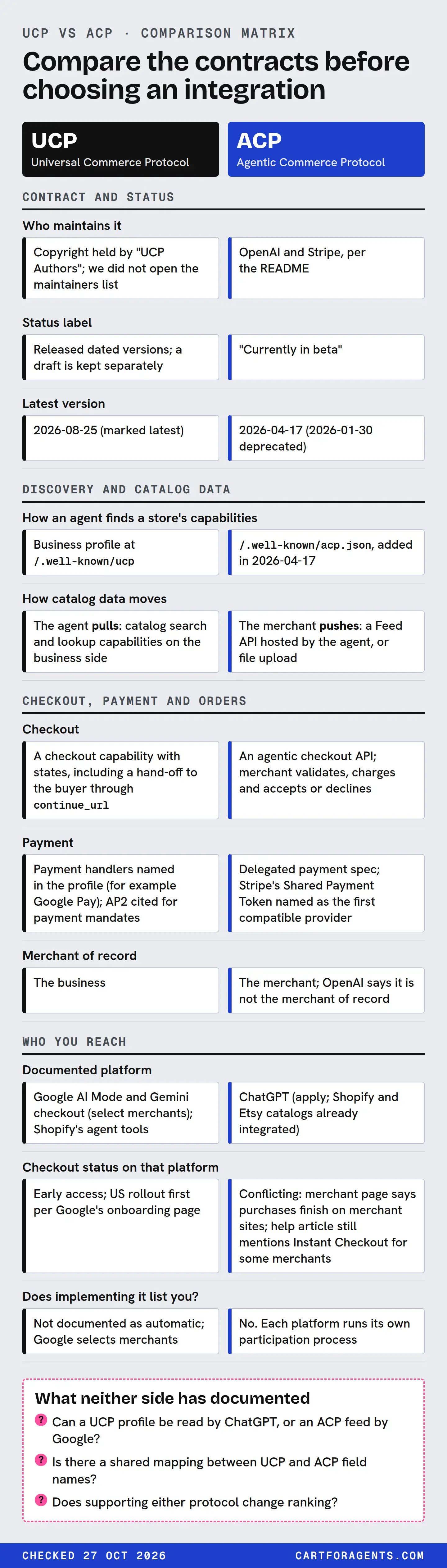
UCP and ACP are both open, date-versioned, Apache-licensed protocols for shopping through AI agents. They are not two names for one thing.
UCP, the Universal Commerce Protocol, has each business publish a profile that platforms read and negotiate against. It is the route Google documents for checkout in AI Mode and Gemini, and the one Shopify’s agent tools implement. ACP, the Agentic Commerce Protocol, is maintained by OpenAI and Stripe and still labelled beta. It has merchants push product feeds to the agent, and it is the protocol behind ChatGPT’s merchant program.
Neither specification says the two interoperate. So pick by the platform you need to reach and the contract that platform documents, not by the protocol’s name. And if you sell on Shopify in the US, you don’t need to build either to be found in ChatGPT: OpenAI says Shopify Catalog already supplies that data.
The comparison matrix
Every cell is what a current document says on October 27, 2026. “Not documented” means we found no statement, not that the feature is missing.
Contract and status
| Dimension | UCP | ACP |
|---|---|---|
| Who maintains it | Copyright held by “UCP Authors”; we did not open the maintainers list. Google and Shopify both document implementations | OpenAI and Stripe, per the README. The maintainers file also lists Meta, added in the unreleased changelog |
| Status label | Released dated versions; a draft is kept separately | “Currently in beta” |
| Latest version | 2026-08-25 (marked latest) | 2026-04-17 (2026-01-30 deprecated) |
| Earlier versions | 2026-04-08, 2026-01-23, 2026-01-11 | 2026-01-30, 2026-01-16, 2025-12-12, 2025-09-29 |
| Licence | Apache 2.0 | Apache 2.0 |
Discovery and catalog data
| Dimension | UCP | ACP |
|---|---|---|
| How an agent finds a store’s capabilities | Business profile at /.well-known/ucp |
/.well-known/acp.json, added in 2026-04-17 |
| How catalog data moves | The agent pulls: catalog search and lookup capabilities on the business side | The merchant pushes: a Feed API hosted by the agent, or file upload |
| Product data as a commitment | Catalog responses are “not transactional commitments”; checkout is authoritative | Feed fields describe display and eligibility; OpenAI says eligibility “does not guarantee display” |
| Negotiation | Platform picks one version; active capabilities are the overlap | Session-level capability negotiation at checkout creation, plus the discovery document |
Checkout, payment and orders
| Dimension | UCP | ACP |
|---|---|---|
| Checkout | A checkout capability with states, including a hand-off to the buyer through continue_url |
An agentic checkout API; merchant validates, charges and accepts or declines |
| Payment | Payment handlers named in the profile (for example Google Pay); AP2 cited for payment mandates | Delegated payment spec; Stripe’s Shared Payment Token named as the first compatible provider |
| Orders after purchase | Order capability | Order webhooks; orders RFC in the repository |
| Merchant of record | The business | The merchant; OpenAI says it is not the merchant of record |
Who you reach
| Dimension | UCP | ACP |
|---|---|---|
| Documented platform | Google AI Mode and Gemini checkout (select merchants); Shopify’s agent tools | ChatGPT (apply; Shopify and Etsy catalogs already integrated) |
| Checkout status on that platform | Early access; US rollout first per Google’s onboarding page | Conflicting: merchant page says purchases finish on merchant sites; help article still mentions Instant Checkout for some merchants |
| Market | Google names the US, Canada and Australia on one page and a US-first rollout on another | Shopping “currently live for ChatGPT users in the U.S.” |
| Does implementing it list you? | Not documented as automatic; Google selects merchants | No. Each platform runs its own participation process |
What neither side has documented
| Question | Status |
|---|---|
| Can a UCP profile be read by ChatGPT, or an ACP feed by Google? | Not documented by either project or platform |
| Is there a shared mapping between UCP and ACP field names? | Not documented |
| Does supporting either protocol change ranking? | Not documented. OpenAI and Google describe ranking inputs, not protocol bonuses |
| Does Stripe’s ACP payment role carry over to UCP? | Not documented in what we read. The ACP site names Stripe’s Shared Payment Token as the first compatible provider; we did not verify any Stripe UCP page |
The three differences that matter to a merchant
1. Pull versus push
UCP puts the catalog on your side. An agent searches it or looks products up through your capabilities, often through your platform. ACP, as OpenAI runs it, puts the catalog on the agent’s side. You push a feed, by file upload (OpenAI recommends a full snapshot at least daily) or through the Feed API added in ACP 2026-04-17.
That changes what goes wrong. With pull, a mistake is usually in what your platform generates or exposes. With push, a mistake is usually a stale or rejected feed row. OpenAI keeps the last processed record for up to 14 days after a product disappears from a snapshot. Our ChatGPT feed guide covers the feed fields.
2. Discovery file versus participation
Both protocols now define a public discovery document. Neither document gets you listed. The ACP website says it plainly: implementing the protocol does not automatically list your products, and each AI platform runs its own process. Google says the same thing in its own way: UCP checkout is for select merchants, and each product must be flagged.
3. Checkout is the moving part
The checkout halves of both protocols are the least settled for merchants:
- Google documents UCP checkout in AI Mode and Gemini as an early access program. Our Google checkout guide walks the eligibility preflight and the market conflict.
- OpenAI’s pages disagree. The merchant page says OpenAI is “moving away from a standalone Instant Checkout experience” and that purchases are completed on merchant-owned sites or apps. The help article says ChatGPT “may also show an Instant Checkout option” for some eligible products and merchants. The developer docs still document the checkout and delegated payment specs, and say checkout needs a separately enabled integration.
When a platform’s own pages disagree, plan for the narrower reading. For ChatGPT today, that means the shopper finishes on your site.
Worked case: one Shopify store, both protocols
Take a labelled hypothetical: Example Humidifier Co., a Shopify store on the Starter plan that sells to US shoppers. Which contracts touch it, and what does it have to build?
| Platform | Protocol named in the docs | What the store has to do, per current docs | What we could see from outside |
|---|---|---|---|
| ChatGPT | ACP | Nothing extra to be discovered: Shopify Catalog supplies product data. A direct feed needs an application. Checkout is not offered as a Shopify setting; buyers finish on the store | No /.well-known/acp.json (404 on all four real stores we checked) |
| Google AI Mode and Gemini | UCP | Keep Merchant Center product data current; for checkout, apply, be selected, integrate, and flag products with native_commerce(checkout_eligibility) |
A UCP profile at /.well-known/ucp listing checkout (all four real stores) |
| Other agents using Shopify’s catalog | UCP | Be eligible for Shopify Catalog: Starter plan or higher and not in private mode, or the Agentic plan exception before the online store is on a paid plan | Products returned by catalog search, with native checkout false |
We checked the right-hand column on four real Shopify stores on October 27. All four served a UCP profile, version 2026-08-25, listing checkout, cart and orders. All four returned 404 for /.well-known/acp.json.
That missing ACP file does not mean those stores are absent from ChatGPT. OpenAI says Shopify merchants reach ChatGPT through Shopify Catalog. The file is a protocol discovery document, not a listing. The lesson for Example Humidifier Co. is that its platform already publishes one protocol’s contract and feeds the other’s platform. The work left is product data, not protocol plumbing.
Choose an integration in four questions
- Which platform do you need to reach? Write it down: ChatGPT, Google AI Mode and Gemini, or agents that use your commerce platform’s catalog. The protocol follows from the platform.
- Does your commerce platform already cover it? Shopify covers ChatGPT discovery through Shopify Catalog and publishes UCP profiles. Check your own platform’s docs before building anything.
- Do you need discovery or checkout? Discovery is mostly product data in the format that platform reads. Checkout is a program with selection, product exclusions and payment setup. Treat it as a separate project.
- Which version will you build against? Pin the dated version (UCP 2026-08-25 or ACP 2026-04-17 on our check date), record it, and re-check the changelog before launch.
If the answer to question 2 is yes, the useful work is the data both routes carry. Our product data guide covers that.
Questions for anyone selling you “UCP and ACP support”
Apps and agencies now advertise protocol support. These questions turn the claim into something you can check:
| Ask | A good answer names | A weak answer |
|---|---|---|
| Which protocol versions? | Dated versions, such as UCP 2026-08-25 or ACP 2026-04-17, and when they’ll move to the next one | “The latest” |
| Which capabilities? | Catalog, cart, checkout or orders, one by one | “Full support” |
| For which platform? | ChatGPT, Google AI Mode and Gemini, or a specific agent, with that platform’s admission status for your store | “All AI agents” |
| What does my platform already do? | What your commerce platform publishes or sends today, and what the app adds on top | Nothing about your platform |
| How will we know it worked? | A dated check you can repeat: a profile fetch, a feed validation report, a product returned on a named route | A visibility score with no method |
Protocol support is plumbing. It can be done well or badly, but nothing we read says it makes an assistant pick your product. We found no OpenAI or Google page that documents a ranking boost for using a protocol.
How we checked
On October 27, 2026 we read the UCP specification overview and its catalog and checkout pages (version 2026-08-25), the UCP version list and GitHub releases, the ACP README, maintainers file, 2026-04-17 changelog, unreleased changelog entries and website FAQ, OpenAI’s merchant page, help article and commerce developer docs, Google’s Merchant Center help and UCP guide, Shopify’s agent docs, and Stripe’s agentic commerce index.
For the worked case we requested /.well-known/ucp and /.well-known/acp.json from the four sellers behind our October 26 Shopify Catalog search for “humidifier for dry winter air large room quiet top fill”. We did not run a checkout or apply to either program.